
Scholarship Overview
You apply directly with the provider. We never charge for applications or ask for payment details. How we verify scholarships
People Also Checked: Martingale Scholarship 2027: Masters & PhD Funding for UK Research (Fully Funded)
Overview
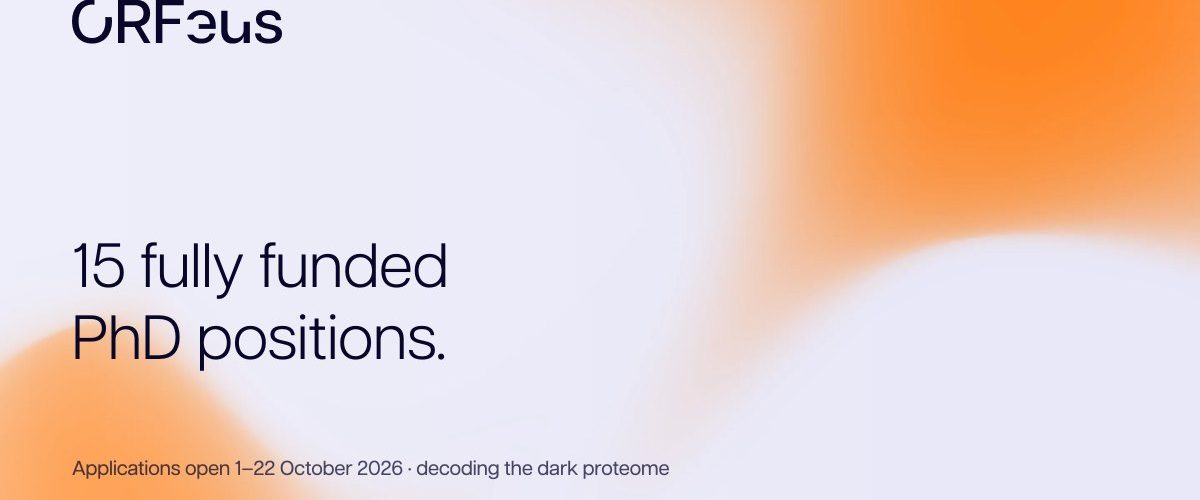
The ORFeus MSCA Doctoral Network is recruiting 15 doctoral researchers for fully funded, 3-year PhD positions starting March 2027. This European Union-funded program investigates microproteins and the “dark proteome”—thousands of small proteins that existing scientific tools have largely missed. The network unites 15 research projects across computational biology, AI, genomics, proteomics, structural biology, evolutionary biology, and cancer immunology.
Each position is a full employment contract with salary and allowances set by the Marie Skłodowska-Curie Actions (MSCA), including a living allowance, mobility allowance, and family allowance where applicable. The program includes mandatory training events, an industry secondment of approximately three months, and an academic secondment of approximately four weeks.
People Also Checked: Imperial College Business School Graduate Teaching Assistant Scholarship 2027: Fully Funded UK PhD (Fully Funded)
Available Projects
The 15 positions are organized across three work packages:
WP1: Discovery (DC1–DC5)
- DC1 (University of Southampton, UK): AI models predicting microprotein genes from DNA sequence data
- DC2 (Max Delbrück Center, Berlin): Single-molecule translation analysis using RiboSTAMP and nanopore sequencing
- DC3 (University of Oslo, Norway): Mining 15,000+ public ribosome profiling datasets for rare translation events
- DC4 (Institute of Cancer Research, London): Dual host-pathogen proteomics during bacterial infection
- DC5 (University of Freiburg, Germany): Chemical tagging of secreted microproteins and receptor identification
WP2: Characterization (DC6–DC10)
- DC6 (Hubrecht Institute, Utrecht): Computational protein design using AlphaFold3 and RoseTTAFold
- DC7 (University of Leeds, UK): Translation of long non-coding RNAs in neuronal development
- DC8 (Hospital del Mar Research Institute, Barcelona): Evolutionary analysis to predict microprotein function
- DC9 (Hubrecht Institute, Utrecht): Single-cell ribosome profiling with CRISPR Perturb-seq
- DC10 (Ghent University, Belgium): Thermal proteome profiling in bacterial microprotein deletion strains
WP3: Translation to Medicine (DC11–DC15)
- DC11 (University of Dundee, UK): Non-canonical translation in HPV-driven cancers
- DC12 (University College Cork, Ireland): Genetic variants altering translation in cancer
- DC13 (Princess Máxima Center, Utrecht): Stress-induced non-canonical translation in cancer
- DC14 (Netherlands Cancer Institute, Amsterdam): CRISPR screens for antigen presentation regulators
- DC15 (University of Lausanne, Switzerland): Machine learning prediction of immunogenic cryptic peptides
Eligibility Requirements
To qualify for ORFeus positions, you must meet all of the following:
People Also Checked: Commonwealth PhD Scholarships 2027: Least Developed Countries & Fragile States (Fully Funded)
- Not already hold a doctoral degree (PhD)
- Hold or obtain a master’s degree (or equivalent qualification granting doctoral access) before the position start date
- Satisfy the MSCA mobility rule: you must not have resided, worked, or studied in your chosen host institution’s country for more than 12 months in the 36 months before recruitment
Short stays such as holidays, conferences, or language courses do not count toward the 12-month limit. The mobility rule is assessed per project, so you may be eligible for positions in some countries but not others. Applicants of any nationality are welcome, including those from outside Europe.
Application Process
Applications are submitted through a central platform, not to individual institutions:
- Review projects: Read all 15 project descriptions and identify those matching your background and interests
- Rank up to three projects: Submit one application per project, ranking your choices in order of preference. You may rank one, two, or three projects
- Submit by deadline: Complete applications must be submitted by 22 October 2026, 23:59 CEST
- Shortlisting: Late October to mid-November 2026—projects review and rank applicants. Non-selected candidates receive immediate notification
- Introductory call: Mid to late November 2026—shortlisted candidates are contacted to schedule a brief call
- Full interview: Early December 2026—candidates present research and provide reference contacts. References are contacted at this stage
- Outcome: All candidates are informed of decisions before end of 2026
Reference letters are not required at application. After shortlisting, you provide up to two reference contacts. If you reach the interview stage, referees are contacted for input.
Funding and Benefits
Each position includes:
- 36-month full-time employment contract
- Living allowance (gross amount varies by host country)
- Mobility allowance
- Family allowance where applicable
- Full coverage of travel and accommodation for mandatory network training events
- Approximately 3-month industry secondment (fully funded)
- Approximately 4-week academic secondment (primarily virtual)
English is the working language for all network activities. Local language fluency is not required.
For African and SADC Applicants
The ORFeus network explicitly welcomes applicants of any nationality. For researchers from Zimbabwe and SADC countries, several considerations apply:
- Mobility rule advantage: If you have not studied or worked in the UK, Germany, Norway, Netherlands, Belgium, Spain, Switzerland, or Ireland in the past three years, you likely satisfy mobility requirements for all positions
- Visa support: Host institutions guide recruited researchers through visa and work permit processes. Start this process immediately upon receiving an offer, as timelines vary
- No local language requirement: All supervision, training, and network events are conducted in English
- Family allowance: Available if you have dependents, increasing your total support package
Industry Partners and Secondments
Each project includes a mandatory industry secondment. Confirmed partners include:
- EMBL-EBI (UK/Germany)
- Oxford Nanopore Technologies (UK)
- EIRNA Bio (Ireland)
- Tesorai (US)
- Bruker (Germany)
- Immudex (Denmark)
- Immagina Biotechnology (Italy)
- Enara Bio (UK)
- myNEO (Belgium)
Some secondment partners are to be announced. The industry placement provides direct experience in commercial research environments and expands professional networks.
Key Dates
- Application opens: 1 October 2026
- Application closes: 22 October 2026, 23:59 CEST
- Shortlisting and intro calls: Late October to late November 2026
- Interviews: Early December 2026
- Decisions communicated: Before end of 2026
- Position start: Around March 2027 (exact date varies by project)
Official scholarship page: https://www.orfeus-dn.eu/apply/
You apply directly with the provider. We never charge for applications or ask for payment details. How we verify scholarships