
Scholarship Overview
You apply directly with the provider. We never charge for applications or ask for payment details. How we verify scholarships
People Also Checked: Reginald F. Lewis Fellowship 2027-2028: Harvard Law School Research Fellowship (Fully Funded)
Overview
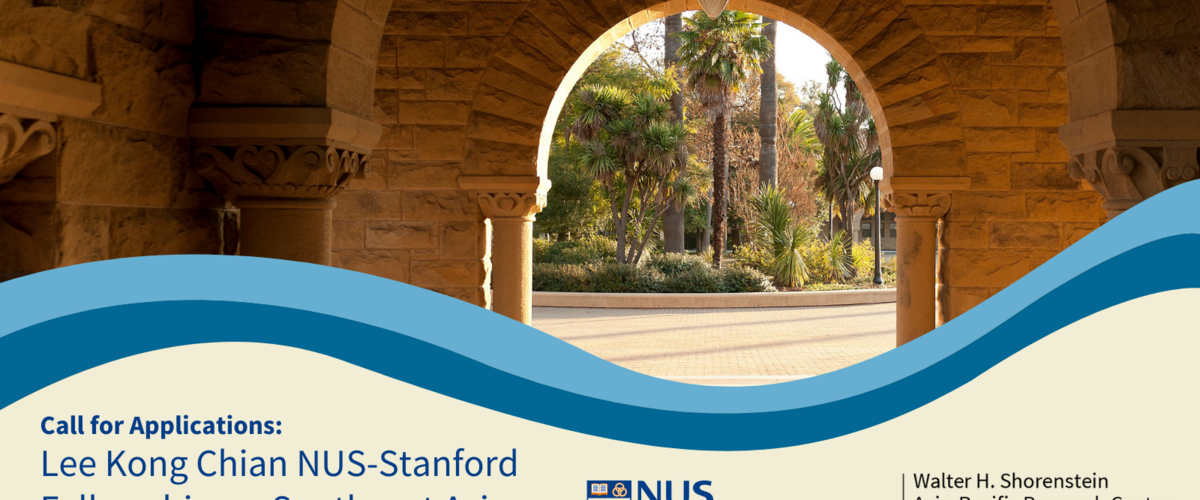
The Lee Kong Chian NUS-Stanford Fellowship on Contemporary Southeast Asia is a prestigious research fellowship for scholars and professionals studying Southeast Asia. Established in 2007 as the flagship component of the Lee Kong Chian NUS-Stanford Initiative, the program enhances scholarship on contemporary Southeast Asian politics, society, economy, and culture.
For the 2027-2028 cycle, the fellowship operates exclusively through Stanford University’s Asia-Pacific Research Center (APARC). The joint-residency model with National University of Singapore (NUS) has been discontinued—applicants wishing to be based at NUS must apply separately through NUS channels.
People Also Checked: Moffitt Cancer Center Postdoctoral Fellowships 2025: Multiple Research Positions (Fully Funded)
What the Fellowship Provides
The fellowship offers substantial financial and institutional support:
- Monthly stipend: US$8,000 for the duration of the fellowship
- Travel: One round-trip economy-class airfare between your home country and Stanford University (exceptions considered for special circumstances)
- Duration: Two to three quarters (approximately 6-9 months)
- Residency period: September 1, 2027 to June 30, 2028
- Research environment: Access to Stanford’s Southeast Asia Program, seminars, workshops, and intellectual community
Eligibility Requirements
The fellowship welcomes diverse applicants:
People Also Checked: Voqal Partners Fellowship 2027: $30,000 for Social Justice Changemakers (Fully Funded)
- Disciplines: Social sciences or humanities
- Career stages: All levels—from early-career researchers to senior scholars
- Nationality: Open to candidates of all nationalities, including African and SADC region scholars
- Employment status: Must have ongoing professional positions or academic affiliations
- Research focus: Projects must center on contemporary Southeast Asia
African scholars with expertise in Southeast Asian studies—particularly those examining comparative development, political economy, religious studies, or environmental issues—are encouraged to apply. The fellowship values diverse geographical perspectives on Southeast Asian affairs.
Required Application Documents
Prepare these materials before beginning your application:
- Curriculum vitae: Full CV including publications
- Project statement: Maximum 3 pages addressing:
- Central analytic questions, interpretations, and arguments
- Intellectual contribution to Southeast Asian scholarship
- Research and writing planned during the fellowship
- Specific expected outcomes
- Fellowship schedule: Detailed timeline with anticipated Stanford residence dates
- Writing sample: Published English-language work related to your research project
- Three academic referees: Full contact information including email addresses
Application Process
Follow these steps to apply:
- Access the online application form through Stanford APARC’s website
- Complete all required fields in the application form
- Upload your CV, project statement, fellowship schedule, and writing sample
- Enter contact information for three academic referees
- Submit the completed application before the deadline
Your referees should be prepared to evaluate both your proposal and your qualifications if contacted.
Selection Timeline
- Application deadline: January 25, 2027 (Pacific Time)
- Results announcement: Spring 2027
- Fellowship period: September 1, 2027 – June 30, 2028
Research Environment at Stanford
Fellows join the Southeast Asia Program within Stanford’s Walter H. Shorenstein Asia-Pacific Research Center (Shorenstein APARC). The program fosters interdisciplinary collaboration across environmental studies, religious studies, political economy, and social change research.
Past fellows describe the community as intellectually vibrant, with opportunities to present work and participate in university-wide seminars and workshops. The 2026 fellow Teren Sevea (Harvard Divinity School) noted how conversations at Stanford “sharpened my thinking and pushed me to reframe my materials for different audiences.”
Notable Alumni
Recent fellows include scholars from Harvard, Northeastern University, University of Hong Kong, University of Queensland, University of Toronto, and Universitas Islam Negeri Ar-Raniry (Indonesia). The program has hosted researchers from Australia, Germany, Indonesia, Malaysia, Singapore, the UK, and the US—demonstrating its global reach.
Contact Information
For application questions:
Kana Igarashi Limpanukorn
Southeast Asia Program
Shorenstein Asia-Pacific Research Center
Encina Hall E-301, Stanford University
616 Jane Stanford Way, Stanford, CA 94305-6055, USA
Email: kilimpan@stanford.edu
Telephone: (650) 723-9744
For international scholar resources, visit Stanford’s Bechtel International Center website.
Official scholarship page: https://aparc.fsi.stanford.edu/education/fellowship-and-training-opportunities/nus-stanford-fellowship-southeast-asia
You apply directly with the provider. We never charge for applications or ask for payment details. How we verify scholarships